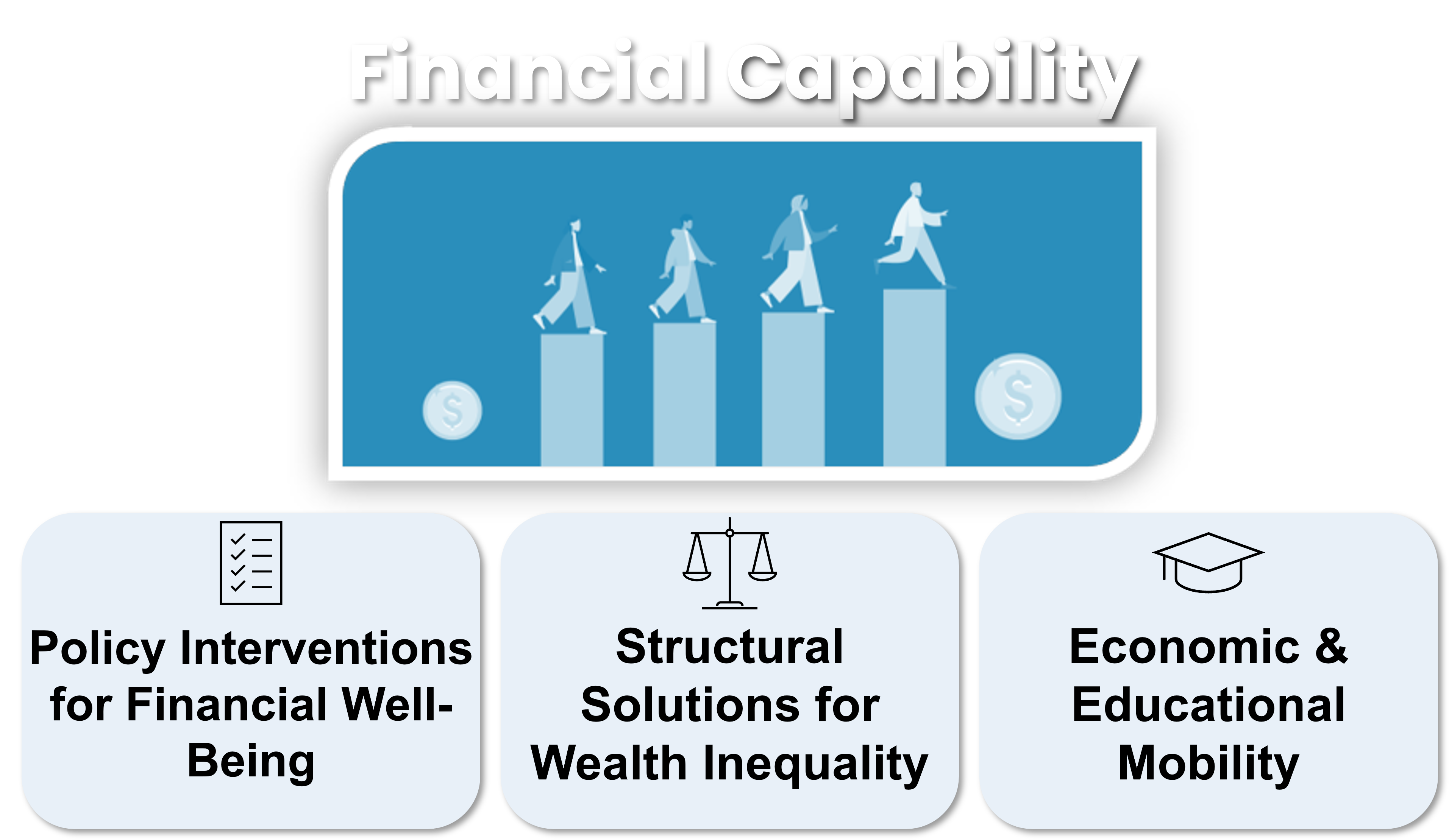
My research as a social policy scholar is dedicated to advancing financial capability and promoting financial well-being and social equity through evidence-based policy. I investigate how institutional structures and policy interventions empower individuals and families to achieve financial security. This page provides an overview of my work across three interconnected themes, moving from understanding financial problems to designing responses that address them.
1. Household Financial Security and Economic Shocks
I study how households experience and respond to economic shocks, including unexpected expenses, income disruptions, high-cost debt, and early retirement withdrawals, and which policies and supports help them recover. My work pays particular attention to low-income and frontline workers and to the role of employer benefits, income supports such as the Child Tax Credit, and student-loan and workforce policies in building financial resilience.
-
Job loss during COVID-19 on early retirement withdrawals: A moderated-mediation analysis
-
The Child Tax Credit Expansion and Financial Well-Being: Evidence from Families’ Emergency Savings and High-Cost Financial Resource Usage
-
Access to Employer Benefits and Financial Insecurity Among Frontline Healthcare Workers
-
Student Loan Policies and Payments during the COVID-19 Pandemic: Closing the Gap or Widening Inequalities?
-
How Did Reskilling During the COVID-19 Pandemic Relate to Entrepreneurship and Optimism? Barriers, Opportunities, and Implications for Equity
2. Wealth Inequality, Poverty, and Structural Responses
My work begins by understanding the roots of wealth and poverty disparities, including the enduring effects of historical racial harms on homeownership and retirement wealth and the different picture that emerges when poverty is measured through both income and assets. From there I turn to structural responses, examining how asset-building policy, including Child Development Accounts, can serve as a platform for reparations and for building wealth from birth.
-
Historical Harms and Racial Wealth Inequality: Evidence from Homeownership and Retirement Savings Accounts
-
Who Stays Poor and Who Doesn’t? An Analysis Based on Joint Assessment of Income and Assets
-
A Policy Platform to Deliver Black Reparations: Building on Evidence from Child Development Accounts
3. Financial Capability and Asset Building
I examine how financial capability, understood as both the ability to manage money and the real opportunity to build assets, supports college saving, educational expectations, and long-term economic mobility for children and families with low incomes. A recurring focus is program design: how features such as automatic enrollment, early awards, and mechanisms that turn everyday spending into contributions can broaden who participates and benefits.
-
A Cross-Sectional Examination of Educational Expectation Among Welfare Users in an Asset Building Program
-
The Role of Children’s Savings Accounts in Promoting Savings for College Among Welfare Recipients: The Case of Harold Alfond College Challenge (HACC)
-
The Impact of Grocery Store Rewards Cards on Saving and Asset Accumulation in Children’s Savings Account Programs
-
Using Children’s Savings Accounts and Early Awards to Build College Savings among Welfare Recipients: The Case of Promise Scholars
-
A Step Toward Measuring Children’s College-Bound Identity in Children’s Savings Accounts Programs: The Case of Promise Scholars
-
Examining Parental Educational Expectations in One of the Oldest Children’s Savings Account Programs in the Country: The Harold Alfond College Challenge
This page only lists peer-reviewed publications. For more information about other publications and ongoing work, see also: CV · Google Scholar